


Going cashless as a small business: the costs, the benefits and what to check first
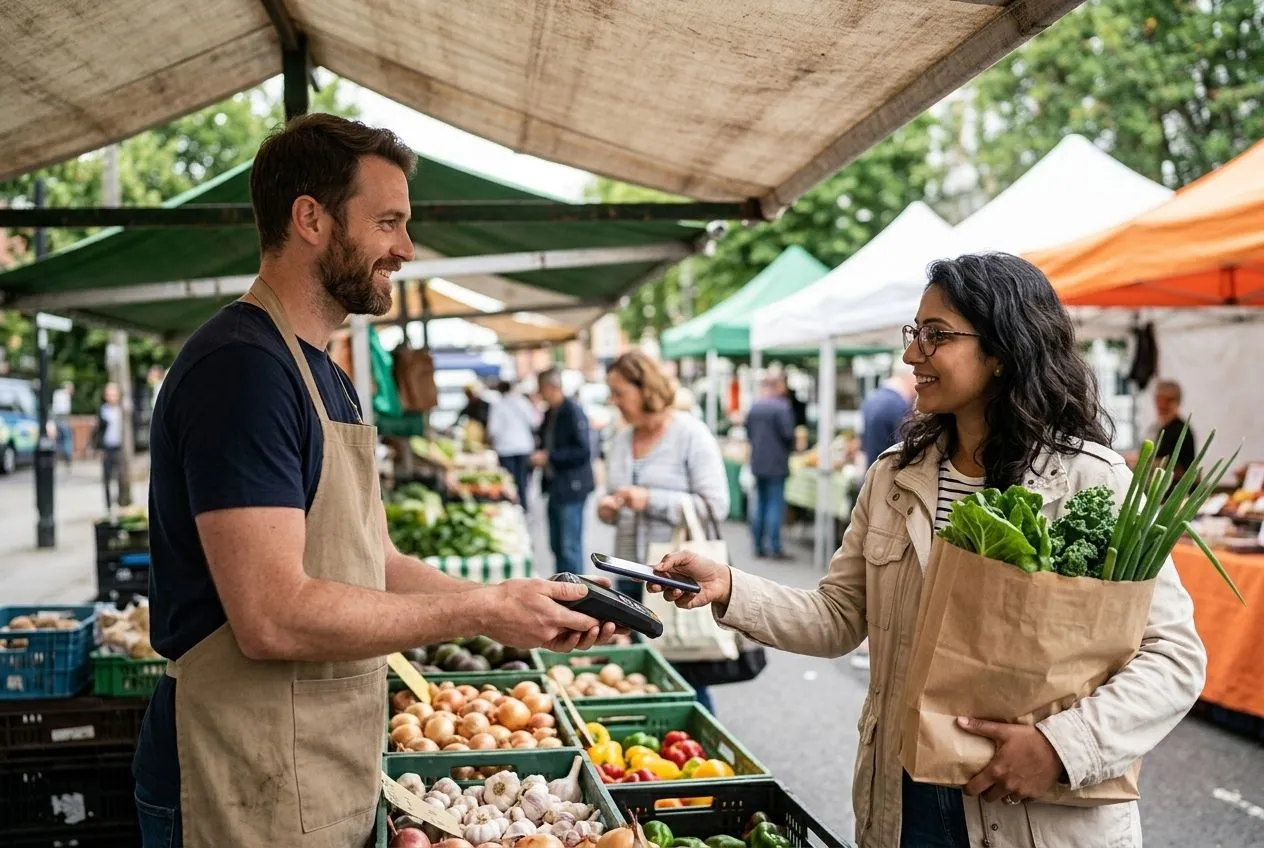
Small businesses used to be the last places in the UK where cash was the norm. That has changed quickly. With cash now used for only 8% of UK payments, most small businesses take cards, and a growing number have stopped taking cash altogether. Going fully or mostly cashless can save time and money, but it is not right for everyone, and the savings depend on what you pay to take cards. This guide sets out the real costs on both sides and what to check before you decide.
The short version
- Customers have moved: cards accounted for 64% of UK payments in 2025 and cash for 8%, according to UK Finance.
- Cash is not free to handle: counting, banking, change, insurance and the risk of loss all cost time or money, even if none of it appears on a statement.
- Cards are not free either: for most small businesses the true cost is somewhere between 1.2% and 2.5% of card takings once every fee is included.
- Going cashless works best when your customers almost all pay by card already, and your card fees are priced properly. Check both first.
Why small businesses are moving away from cash
There are 5.69 million private-sector businesses in the UK, and three-quarters of them have no employees. For a business that small, every hour spent counting a till, driving to a bank or chasing a missing £20 is an hour of the owner's time.
The case for cards is now mostly about the customer. UK Finance's 2026 report found that debit cards alone accounted for 54% of all UK payments in 2025, contactless for 39%, and that 58% of adults use their phone to pay at least once a month. Many customers simply do not carry cash. Taking cards is no longer a convenience for them; not taking cards is an inconvenience they will avoid.
The hidden cost of cash
Cash has no transaction fee, which makes it look free. It is not:
- Time: counting and reconciling the till, preparing bank deposits, and getting change.
- Banking: many business bank accounts charge for paying in cash, and with branch closures, getting to a bank or Post Office can take a trip.
- Security and insurance: cash on the premises or in transit is a theft risk, and insurers may limit how much you can hold.
- Errors and shrinkage: miscounted change and missing takings are hard to trace.
- Record-keeping: every cash sale has to be recorded by hand or through a till, where card payments arrive with a digital record.
Record-keeping matters more from 2026. Under Making Tax Digital for Income Tax, sole traders and landlords with qualifying income over £50,000 have had to keep digital records and send quarterly updates to HMRC since April 2026, with the threshold falling to £30,000 in April 2027 and £20,000 in April 2028. Card takings that feed straight into your accounts make that much easier.
The real cost of cards
Card payments cost more than the headline rate. A typical small business pays a percentage on each sale, plus authorisation fees of a few pence per transaction, terminal rental, and sometimes a minimum monthly charge and PCI fees. Our guide to card machine fees goes through every line, and shows a café paying a "1.4%" rate whose real cost was 2.44% of its takings.
For a business taking £10,000 a month in cards, the difference between a well-priced deal and a poorly priced one can easily be more than £1,000 a year. That is why the decision to go cashless and the decision about your card provider belong together: moving more takings onto cards makes your card fees a bigger overhead.
To see what your own card payments cost, put your takings and charges into our free card fee calculator. It works out your effective rate and your monthly and yearly cost.
Should you go fully cashless?
Going card-only suits businesses where:
- almost every customer already pays by card or phone;
- payments are mostly small and frequent, so the cost of handling cash is high relative to each sale;
- staff security or cash handling is a real concern, for example late-night trading.
Keep taking cash if:
- a meaningful share of your customers are older, on low incomes, or visitors who prefer cash;
- you trade somewhere with unreliable signal and no backup;
- your local area or customer base expects it, for example at some markets and events.
There is no general legal requirement for a business to accept cash in the UK. But going cashless can lose you some customers, so many businesses take cards by default and keep cash as a fallback. If you do go card-only, say so clearly at the entrance and the till.
What to check before you decide
- What your customers already do. Count a typical week: what share of sales are cash? If it is under 10%, going cashless will rarely cost you much trade.
- What your card payments really cost. Upload one statement to our free card fee check to see your total fees in pounds and your effective rate.
- How quickly you get paid. Next-day settlement is widely available. If yours takes two or three days, ask why.
- What happens when something fails. Have a backup: a second terminal, a 4G terminal that does not rely on your broadband, or Tap to Pay on your phone.
- Whether the setup fits how you trade. A countertop or portable card machine, an EPOS system that records every sale, or both.
How we help
Pulsare Pay prices card processing across several acquirers, so the rate reflects your real turnover and card mix rather than one provider's rate card. Whether you are going cashless, taking cards for the first time, or just want a lower bill, the starting point is your real number. If you do not take cards yet, use our sign-up form and we will price a setup from your expected turnover.
Questions people ask
Is it legal for a UK business to refuse cash?
Yes. There is no general legal requirement for a UK business to accept cash, although it is good practice to make it clear before a sale.
What does it cost a small business to accept card payments?
Usually between 1.2% and 2.5% of card turnover once every fee is included: the transaction rate, authorisation fees, terminal rental and any monthly charges.
How much cash do people in the UK use?
Cash was used for 8% of all UK payments in 2025, according to UK Finance, down from 17% in 2020 and 45% in 2015.
Do card payments help with Making Tax Digital?
Yes. Card payments come with a digital record of every sale, which makes it easier to keep the digital records and send the quarterly updates that Making Tax Digital for Income Tax requires.